
America’s Great DisastersPage
2
2
The Great Johnstown Flood
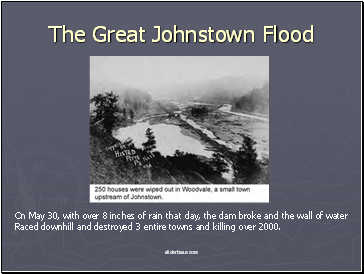
On May 30, with over 8 inches of rain that day, the dam broke and the wall of water
Raced downhill and destroyed 3 entire towns and killing over 2000.
Slide 12
The Great Johnstown Flood
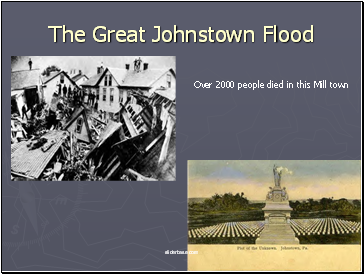
Over 2000 people died in this Mill town
Slide 13
The Great Johnstown Flood
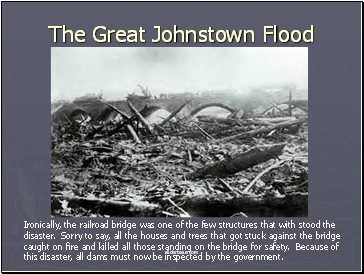
Ironically, the railroad bridge was one of the few structures that with stood the
disaster. Sorry to say, all the houses and trees that got stuck against the bridge
caught on fire and killed all those standing on the bridge for safety. Because of
this disaster, all dams must now be inspected by the government.
Slide 14
The Great Drought
During the 1930’s (The Depression), there was little to no rain in the Mid-West
With no rain, trees (wind breaks) and over farming, the topsoil “blew away”
The Midwest was known as the Great Dustbowl
It forced many farmers to lose their farms and move to find work
Slide 15
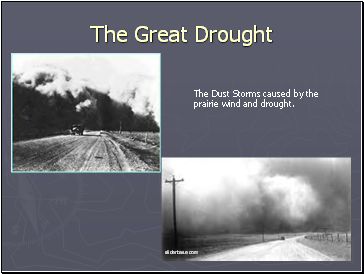
The Great Drought
The Dust Storms caused by the
prairie wind and drought.
Slide 16
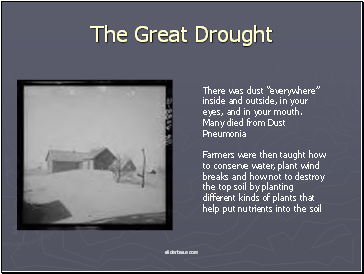
The Great Drought
There was dust “everywhere” inside and outside, in your eyes, and in your mouth. Many died from Dust Pneumonia
Farmers were then taught how to conserve water, plant wind breaks and how not to destroy the top soil by planting different kinds of plants that help put nutrients into the soil
Slide 17
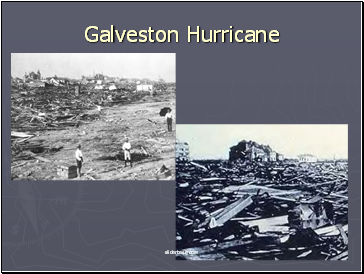
Galveston Hurricane
September 8, 1900
Winds were up to 150 miles per hour
Storm surge of over 16 feet
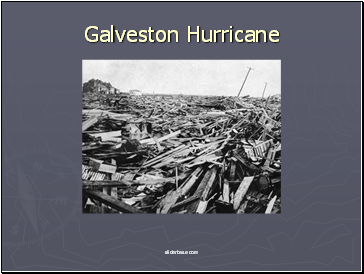
Over 6,000 people killed on Galveston Island
Another 6,000 were killed in Texas
Worst Hurricane ever to hit the USA
Slide 18
Galveston Hurricane
Slide 19
Galveston Hurricane
Slide 20
Galveston Hurricane
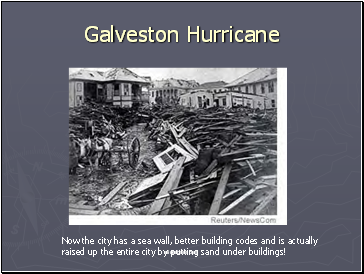
Now the city has a sea wall, better building codes and is actually
raised up the entire city by putting sand under buildings!
Slide 21
Blizzard of 1888
March 11, 1888
New England states were pounded with freezing temperatures, 70 mph winds and massive amounts of snow
Contents
- Great Disasters
- Sultana Explosion
- Sultana
- The General Slocum Disaster
- The Great Johnstown Flood
- The Great Drought
- Galveston Hurricane
- Blizzard of 1888
- Influenza Pandemic of 1918
- The San Francisco Earthquake
- The Wisconsin Forest Fire
- October 8th 1871 Another disaster is smoldering…
- The Great Chicago Fire of 1871
- “A City Ready to Burn”
Last added presentations
- Newton’s laws of motion
- Gravitation
- Sound
- Static and Kinetic Friction
- Health Physics
- Magnetic field uses sound waves to ignite sun's ring of fire
- Mechanical, Electromagnetic, Electrical, Chemical and Thermal